Wednesday, October 07, 2009


Capacity for what?
 Earlier this year I was in Vietnam working on capacity building for local government concerning participatory planning and reviewing a new curriculum for planners education at undergraduate level. The issue arising is the increasing demands, especially with the additional challenge of climate change in a major delta area. At the same time there is no more time for study - so what goes out and what comes in? The need to be able to innovate and adapt to change becomes a vital area. The importance of ethics is also increasing in importance as planners often have to mediate between public interest and the pressures of the market.
I have just been to the World Habitat Day celebrations in Brussels. The focus was on urban planning - the theme that UN-HABITAT is promoting in its state of cities report - which is available for download in its abridged form - a welcome initative. The key word coming up is integration, in particular integration with preventative measures linked to climate change and disaster management. I agree, but a major issue is that capacity is already limited to do the often ineffective planning that is a weak response to a vital issue - managing fast growing cities with increasing informality.
The Brussels meeting was hot on the heals of the N-Aerus conference on Open Cities held at IHS in Rotterdam. Again the scale of the challenge was highlighted in terms of growing difference in access to services, made worse with gated communities in countries as diverse as Brazil and Egypt.
The challenge is not just to add additional tasks to often weak organizations, but to radically rethink the work that should be done and also to get rid of the barriers that stop effective action. Many enthusiastic young planners become disillusioned because of work place inertia, lack of politica and manageral support and often also corruption. Add in poor pay levels and it is not surprising that some of potentially the most significant tasks are being done poorly or not at all. We need to find ways to better tap into human energies and potentials that we build and not to allow them to be sapped away.
Saturday, February 07, 2009
Update - what's in a name?
A long time without posting - but the site was specially set up for events in the WUF in Vancouver in 2006. Since then, the issue has not gone away. Unfortunately in many cases a major impediment is the willingness or ability of governmental institutions to pay staff sufficiently to attract and keep good staff.
In the meantime, the terminology has moved on in some circles. "Capacity Development" is the term favored by UNDP, who have been doing a lot of work in the area. The difference in concept is explained as "capacity development" assumes that there is existing capacity to be built on, while "capacity building" does not. This is rather an artificial difference, because most of the use of "capacity building" is in contexts of working with existing capacity. What matters is that useful information can be found under both headings.
http://capacity.org/ is still a very useful site.
Monday, July 03, 2006

Friday, June 23, 2006
Capacity Building event in Vancouver

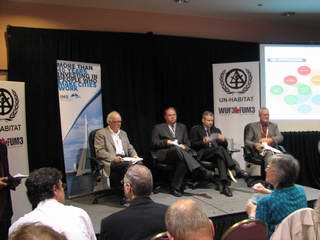
Nice idea to post daily updates, but the reality of an event like WUF means very little time. Anyway, the event went well, with standing room only and a lot of good participation. We are working on the report of the session, and will post it on this site.
Meanwhile a very full week with all our sessions going well and Holland managing to hold Brazil to a draw. The forum and the sessions are important, but the real work goes on in the corridors , which here gives a lot of space, and now that the weather is warmer, the terrace by the water is getting busy.
Now the last day, but not much time yet to reflect.
Monday, June 19, 2006
Setting up in Vancouver



9 hours time difference from Netherlands and some sensitive World Cup games conspire to make thinking less clear - but we have got the IHS stand up and running and met all the partners for the Capacity Building event. Sunday evening saw the opening reception, and very busy crowds at the stand. Many former colleagues and former participants - great to see people again.
Making sure there will be plent of people at the event needs aggressive marketing. People making calls may not find the right number, but they will find the best events. IHS is working with partners on 6 events - including generating mass support for Hollands match against Argentina on Wednesday.
Monday, June 12, 2006
MAPP, programme AP India as case
Banashree Banerjee writes:
The Municipal Action Plan for Poverty Reduction (MAPP) being used on DFID projects in India is an excellent on the job cap-build tool for local govt, civil society and for throwing up demand based training requirements. Also prompts policy and legislative action at higher levels.
APUSP Project Coordinator Mr Janardhan Reddy has been asked to send the case.
Links www.apusp.org
janardhana_b2001@yahoo.co.in.
Have also asked RADOL Bangladesh to contribute
Friday, June 09, 2006
Useful links
For more information on the partners cooperating in the capacity building event at WUF in Vancouver
WUF, Vancouver
This report outlines the strategy developed at Habitat II in Istanbul
This site provides a lot of information developed in the Support to the implementation of national plans of action, SINPA, which tried to put into practice strategies developed in Istanbul Bangladesh , Bolivia and Zambia
Housing Development Management, Lund , Sweden
Training and capacity building branch, UN Habitat
Promesha case
Capacity Building in Aceh

Here are some links to work that it being carried out on capacity building for monitoring after the Tsunami in Aceh
"I am very pleased to accept your offer to post contributions from Aceh housing reconstruction on your web site
"I am very pleased to accept your offer to post contributions from Aceh housing reconstruction on your web site
Please find attached the Housing Briefing February 2006.
Also please add links to the following newsletters
Land Tenure:
Construction Quality:
Earthquake resistance:
Please let me know if you have any problem with the above links.
Thank you very much for your very kind offer of posting them.
I look forward to attending your event."
Francesca Campagnoli
Francesca Campagnoli
Sharing experience- case studies
Introduction
Capacity Building has become a standard part of many programmes, but have we been learning lessons, and what are they? How do we know if we are increasing our impact and making cities better?
At Istanbul we ran a major series of presentations and discussions named “Capacity Building for Better Cities”. Since then many major institutions have been trying to innovate and also also to take better stock of what has been happening. The networking event will review some of the key obstacles to progress and share useful innovations. Speakers will include Forbes Davidson of IHS, Johnny Astrand of Housing Development and Management, Lund, Caren Levy of DPU and Raf Tuts of UN Habitat’s training and capacity building branch. Banashree Banerjee will moderate and ensure that participants in the event will have a chance to make inputs and help decide on the most strategic way forward.
The session itself will not allow for long presentations. Programmed inputs will be on 5 minutes and interventions from the floor limited initially to 3 minutes. To allow more information to be shared we request that cases referred to be submitted in the following format. The description should be short and to the point, but can refer to other fuller documentation. We request that outlines be sent to urbancapacity@gmail.com
We are particularly looking for cases that illustrate the importance of working with awareness of the need to achieve the necessary conditions for effective capacity, where individual capacities are supported by a good institutional conditions and a supportive national framework and international framework.
Outline for case studies for Capacity Building for Better Cities: what have we learned?
The following headings and annotations should be used as a guide for a short overview both for presentations and written descriptions.
Key data:
Name of programme or project
Starting point/ initiative
Who initiated the programme and what was the context.
Date started Date ended (if finished)
Scale of project
A brief description of the number of people or institutions worked with.
Description of key features and reason for interest
What is the programme? What are special features that make it interesting?
At what levels does it operate?
We are interested about the way capacity building programmes try to work at the different levels of individual/ institution/ national framework/ International framework (where relevant)
What are seen as the main local challenges to developing effective capacity
What are the special challenges that have had to be overcome. For example in some countries government salary scales are very low.
Is there any evidence so far of impact? If so, what is it and how was it assessed?
Impact assessment is generally a weak area in capacity building. Does the case try to address this? Are there any results?
Is the process introduced sustainable?
New initiatives are often introduced through programmes and projects. This increases the risk that the intervention will not be sustainable. What measures have been taken to avoid this and are there any signs of success?
Is it possible to upscale - Locally? Globally?
What do you think are the main lessons we can learn which are relevant for making capacity building efforts more effective and or more efficient in future?
Subscribe to:
Posts (Atom)

 Posts


